
Drag racing games strip away the corners, the traffic, and the open-world filler. What’s left? Pure, unfiltered acceleration. Two cars, a quarter-mile stretch of asphalt, and the player who nails the launch, shifts, and tune walks away with the win. It’s racing distilled to its most intense form, where a single mistake costs you the race, and perfection feels like launching a rocket.
PC has always been the premier platform for drag racing enthusiasts who want precision control, deep customization, and the hardware to push these games to their limits. Whether players crave simulation-level tuning where carburetor jets and tire pressure matter, or arcade thrills where nitrous explosions light up the screen, the PC library delivers. This guide breaks down the best drag racing games available in 2026, what separates the contenders from the pretenders, and how to master the mechanics that turn milliseconds into victories.
Key Takeaways
- Drag racing games on PC deliver pure acceleration-focused gameplay where perfect launch technique, precise shifting, and optimal tuning determine victory within just 6–10 seconds of intense competition.
- No Limit Drag Racing 2 sets the simulation standard with advanced physics modeling tire slip, weight transfer, and component-level engine customization, while Pixel Car Racer offers accessible arcade-style fun for casual players seeking dopamine-hit racing.
- Successful drag racing requires mastering three core mechanics: launch technique with throttle and clutch coordination, shift timing to keep engines in their powerband, and track-specific tuning that adapts to conditions like temperature, altitude, and quarter-mile length.
- The PC platform excels for drag racing games because of robust mod communities, precise input control via racing wheels and controllers, and consistent frame rates essential for millisecond-level reaction timing in competitive multiplayer.
- Future drag racing games will likely expand through VR immersion, AI-driven tuning assistants, cross-platform multiplayer, and esports tournament formats that make competitive drag racing as watchable as it is playable.
- Start your drag racing journey with accessible titles like Pixel Car Racer to learn the rhythm, then progress to hardcore sims like No Limit Drag Racing 2 as your tuning expertise and competitive ambitions grow.
What Makes Drag Racing Games Unique?
Drag racing games occupy a niche corner of the racing genre, but their focus creates gameplay unlike anything else on four wheels. Traditional racing games reward cornering skill, racecraft, and lap-after-lap consistency. Drag racing? It’s all about those six to ten seconds of absolute precision.
The entire experience compresses into a few critical actions: staging the car correctly, launching at the exact moment the tree goes green, modulating throttle and clutch to prevent wheelspin, shifting at peak RPM without missing the powerband, and, in many titles, managing nitrous deployment for maximum effect without blowing the engine. Miss any of these by a tenth of a second, and the opponent disappears into the distance.
This intensity creates a different kind of pressure. There’s no chance to recover from a mistake, no next corner to make up time. Launch too early? Red light disqualification. Bog the engine off the line? The race is already over. Shift too late? Watch the tach bounce off the limiter while precious speed bleeds away.
The other defining element is the depth of vehicle tuning and customization. Drag racing culture obsesses over incremental gains, swapping gear ratios, adjusting suspension stiffness, changing tire compounds, tuning fuel mixtures. The best drag racing games mirror this obsession, letting players jump into engine builds where a different camshaft or turbo size fundamentally changes the car’s power delivery. It’s not uncommon to spend more time in the garage than on the strip, chasing that perfect setup for a specific track and weather condition.
Multiplayer takes on unique dynamics too. In circuit racing, skillful driving can overcome a slightly slower car. In drag racing, the combination of perfect execution and optimal tuning is everything. Online leaderboards become battles of hundredths of seconds, where the meta shifts with each physics update or balance patch.
The Best Drag Racing Games for PC in 2026
The PC drag racing scene in 2026 offers something for every type of player, from hardcore sim racers who want to calculate air-fuel ratios to casual players who just want to mash the gas and watch cars fly.
Simulation-Focused Drag Racing Titles
No Limit Drag Racing 2 remains the gold standard for simulation drag racing on PC. The 2024 release brought a complete physics overhaul that models tire slip, weight transfer, and driveline shock with frightening accuracy. Players deal with real-world challenges: engine temps affecting power output, track temperature changing grip levels throughout the day, even chassis flex under hard acceleration.
The customization depth is absurd in the best way. Engine builders can swap individual components, pistons, rods, crankshafts, cylinder heads, each with different weight, strength, and performance characteristics. Tuning screens include options for ignition timing curves, boost controllers with per-gear settings, and suspension geometry adjustments that actually matter. The game doesn’t hold hands: players either learn how these systems interact or they lose.
Multiplayer lobbies support bracket racing with full tree practice, heads-up classes with strict build rules, and no-prep events where grip is minimal and wheelspin management becomes critical. The competitive scene has grown significantly since the February 2025 update added ranked seasons with class restrictions.
Automation + BeamNG.drive integration deserves mention for players who want to build their drag car from scratch. While neither game is exclusively drag-focused, the workflow of designing an engine and chassis in Automation, then exporting it to BeamNG for actual quarter-mile testing, creates unmatched creative freedom. The physics in BeamNG handle drag launches impressively well, though the lack of formal drag racing structure means players need to set up their own events.
Street Outlaws 2: Winner Takes All targets fans of the Discovery Channel show but delivers legitimate simulation depth beneath the TV license. The game models small-tire vs. big-tire physics convincingly, and the career mode’s progression through different racing circuits captures the underground scene’s escalation from street racing to organized events. Physics updates through 2025 improved tire model accuracy, making launches less forgiving but more realistic.
Arcade-Style Drag Racing Games
Pixel Car Racer continues its reign as the most accessible drag racing experience on PC even though starting life as a mobile title. The 2025 PC port added native controller support, improved graphics scaling for 4K displays, and a dyno tuning system that strikes the perfect balance between depth and approachability.
The appeal is immediate: buy a car, bolt on parts, hit the strip. Tuning exists but doesn’t require a mechanical engineering degree. Adjust gear ratios with a simple slider, pick a tire compound, set nitrous stages, done. The game shines in its car variety, everything from classic muscle to modern supercars to absurd swaps like a V12-powered Honda Civic.
Progression feels rewarding without excessive grinding. Winning races earns cash for better parts, and the performance gains are immediately noticeable. It’s the perfect game for players who want the dopamine hit of a perfect run without studying clutch engagement curves for an hour first.
CSR Racing 2 made the jump from mobile to PC in late 2025, and the transition was surprisingly successful. The core gameplay loop, timing shifts during automated runs, sounds shallow on paper but becomes genuinely engaging when chasing perfect times. The graphics update for PC hardware is impressive, with car models that rival AAA racing titles.
The free-to-play model can be grindy, but the racing itself is pure timing-based skill. Learning each car’s optimal shift points, when to deploy nitrous for maximum effect, and how to tune for specific opponent times creates genuine depth. PvP lobbies stay active, and the regular content updates keep the meta fresh.
Forza Motorsport (2023) isn’t a dedicated drag racer, but its drag mode deserves recognition. Turn 10 nailed the physics for standing-start acceleration, and the game’s massive car roster means endless matchup possibilities. The tuning system is comprehensive without being overwhelming, and custom lobbies let players set up proper drag events with friends. While it lacks the specialized features of pure drag games, it’s the best option for players who want drag racing as part of a broader racing package.
Free-to-Play Drag Racing Options
Midnight Racing: Tokyo launched in early 2026 as a free-to-play title focused on Japanese street racing culture. The drag racing mode captures the expressway battle vibe, with short sprints from rolling starts rather than traditional quarter-mile launches. It’s less technical than pure drag sims but nails the atmosphere.
Monetization relies on cosmetic items and convenience features rather than pay-to-win car upgrades, which keeps competitive integrity intact. The playerbase stays healthy, and the developers push monthly updates with new cars and events.
Nitro Nation World Tour offers free-to-play drag racing with licensed real-world cars. The core gameplay focuses on timing-based shifting similar to CSR Racing, but the tuning system goes deeper than expected for a F2P title. Players can adjust everything from final drive ratios to suspension settings, and these changes genuinely affect performance.
The grind can be real, higher-tier cars require significant time investment or money, but the matchmaking system generally pairs players against similarly built opponents. Cross-platform play keeps lobbies populated, though PC players have an advantage in precision timing with keyboard or controller inputs over mobile touch screens.
Key Features to Look for in Drag Racing Games
Not all drag racing games are created equal. Knowing what features separate a deep, replayable experience from a shallow time-waster saves both money and disappointment.
Customization and Tuning Options
The depth of the garage determines how long a drag racing game stays installed. Surface-level customization, picking from three preset tunes and changing paint colors, gets boring fast. Look for games that let players actually affect performance through meaningful choices.
Engine modifications should go beyond simple tier upgrades. The best games let players choose specific components: different turbo sizes with distinct spool characteristics and power curves, camshaft profiles that shift the powerband, and intake/exhaust combinations that actually change torque delivery. Weight reduction options, driveline upgrades, and even fuel system changes add layers of strategy.
Transmission tuning is critical. Games that only offer automated shifting miss half the skill ceiling. Manual control with clutch options raises the challenge significantly. The ability to adjust individual gear ratios, not just final drive, allows players to optimize for different track lengths and power delivery curves.
Suspension and tire options matter more than casual players expect. Launch and weight transfer physics mean that suspension stiffness, ride height, and tire compound choices can be the difference between a perfect 60-foot time and spinning uselessly off the line. Games that model these variables authentically reward players who invest time understanding them.
Realistic Physics and Mechanics
Physics make or break immersion in drag racing games. The feeling of managing wheelspin off the line, sensing when to upshift based on engine note and tach position, and experiencing the g-force of hard acceleration all depend on convincing physics modeling.
Tire physics are especially critical. Realistic drag games model tire slip dynamically, cold tires behave differently than hot ones, track temperature affects grip, and burnouts actually serve a purpose beyond looking cool. Games where tires either grip or don’t, with no middle ground, feel arcade-y in a bad way.
Weight transfer simulation affects launch technique significantly. In real drag racing, the weight shifts rearward under acceleration, loading the drive tires for better grip. Games that model this let players use suspension tuning to optimize weight transfer timing. Without it, tuning becomes meaningless number adjustment.
Engine simulation depth varies widely. Basic games treat engines as simple power curves. Advanced sims model turbo lag and boost buildup, supercharger whine and instant response, nitrous oxide injection timing, and even engine failure from over-revving or detonation. These systems transform racing from memorized timing patterns into reactive driving.
Multiplayer and Online Competition
Drag racing against AI loses appeal quickly since patterns become predictable. Robust multiplayer keeps games alive long-term. Matchmaking quality matters, getting paired against opponents with similar build restrictions and skill levels ensures competitive races rather than blowouts.
Ranked modes with seasonal leaderboards give competitive players something to chase. Class restrictions prevent the game from becoming “whoever has the fastest car wins” and instead reward tuning optimization and driving precision within specific builds.
Ghost racing and async competition work surprisingly well in drag games. Players can race against recorded runs from friends or top leaderboard times, creating competition without requiring simultaneous online presence. Time attack events with limited attempts add tension, no infinite retries to eventually luck into a perfect run.
Community features like crew systems, shared tunes, and tournaments organized by players or developers extend longevity. Games that support custom lobbies with adjustable rules let the community create their own competition formats and keep things fresh.
How to Get Started with PC Drag Racing Games
Jumping into drag racing games can feel overwhelming when faced with walls of tuning options and mechanics that punish mistakes instantly. Breaking it down into manageable steps smooths the learning curve.
Understanding Drag Racing Mechanics and Controls
Drag racing boils down to a few core mechanics that every game implements in some form. The staging process positions the car at the starting line. Most games use a Christmas tree light system: pre-stage (front tires at the sensor), stage (rear tires at the sensor), then yellow countdown lights followed by green to launch.
Launch technique determines the race outcome before the car even moves. Too little throttle or too much clutch slip means a slow start. Too aggressive and the tires break loose, smoking away precious momentum. Finding the balance requires understanding the specific car’s power delivery and the game’s tire physics.
Shifting strategy depends on the engine’s powerband. The goal is keeping RPMs in the range where the engine produces peak power. Shift too early and the engine drops out of the powerband: too late and it bounces off the limiter making zero additional power. Manual transmission games reward learning each car’s optimal shift points by sound and tach position.
Nitrous management adds a strategic layer. Single-stage nitrous is simple, deploy when it provides maximum benefit, usually after launching cleanly to avoid immediate wheelspin. Multi-stage systems let players run progressively larger shots through the gears, requiring timing decisions about when each stage activates.
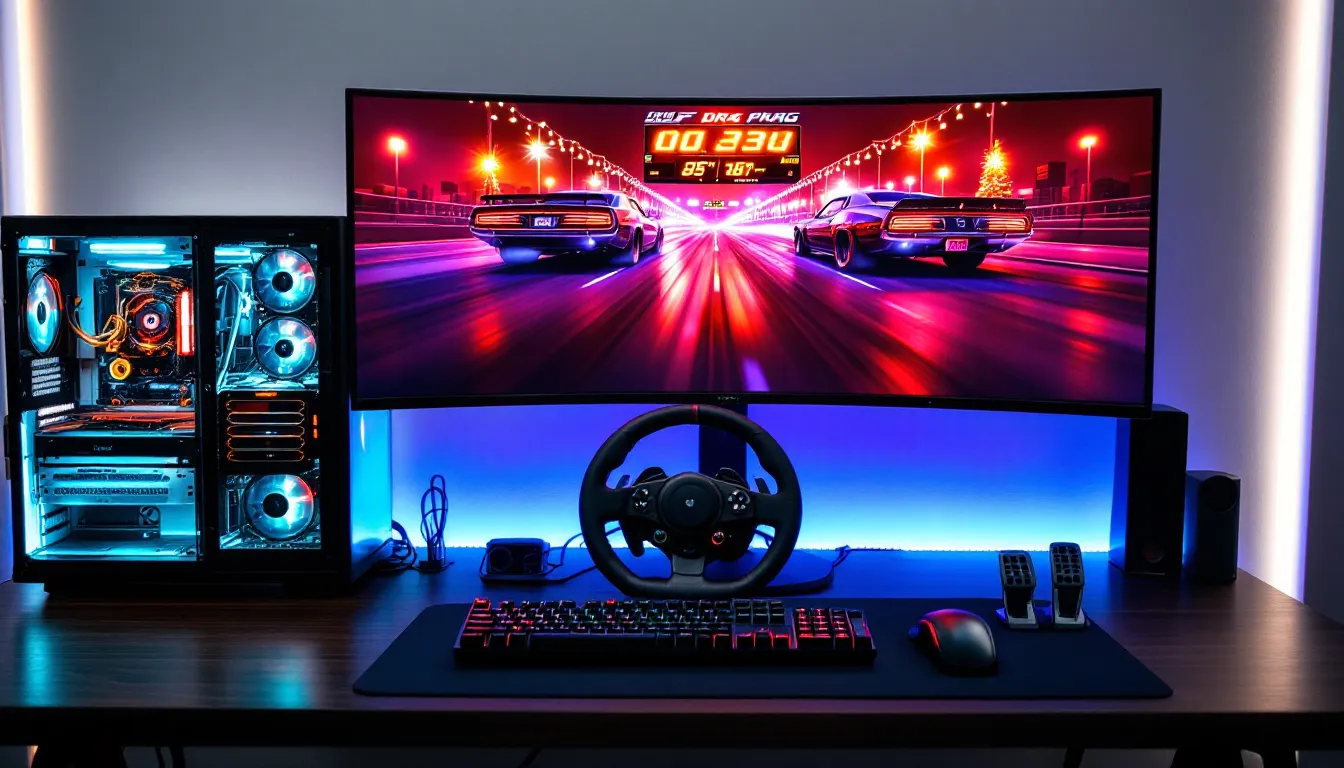
Control setup matters enormously. Keyboard can work for timing-based arcade games, but anything requiring throttle modulation benefits massively from analog controller triggers or, even better, a racing wheel with pedals. Using gaming PC optimization techniques ensures the system delivers consistent frame rates, which directly affects timing precision in reaction-based launches.
Recommended PC Hardware and Setup
Drag racing games aren’t graphically demanding compared to open-world racers, but consistent performance matters more than peak eye candy. Frame rate stability prevents timing inconsistencies during launches and shifts.
Most modern drag racing titles run comfortably on mid-range hardware. A GTX 1660 or RX 5600 XT handles current games at 1080p with high settings. CPU demands are light since drag racing doesn’t render complex traffic or large track environments, even a Ryzen 5 3600 or Intel i5-10400 provides headroom.
Frame rate consistency beats maximum frames. A locked 60 FPS with zero drops provides better timing consistency than 144 FPS that stutters during launches. Enable V-Sync or use frame rate limiters to prevent tearing and maintain rhythm.
Input lag is the enemy of perfect reaction times. Use wired controllers when possible to minimize wireless latency. Disable unnecessary background processes that might cause frame time spikes. Running games in fullscreen exclusive mode rather than borderless window reduces input delay on most systems.
Display refresh rate affects reaction timing in games with light-based starts. A 144Hz monitor gives more visual frames of the tree lights changing, potentially improving reaction consistency. The difference is marginal, but at competitive levels, every millisecond counts.
Wheel and pedal setups aren’t necessary for most drag racing games, but they elevate immersion and control significantly. Load cell brake pedals don’t matter for drag racing, but a quality throttle pedal with smooth resistance curve helps modulate launches. Clutch pedals enable authentic three-pedal driving in sims that support it, adding another skill dimension.
Storage speed barely matters since drag racing games have minimal asset streaming during races. An SSD improves loading times between events but doesn’t affect actual gameplay performance. Save the fast NVMe drive space for open-world games that benefit more.
Mastering the Art of Drag Racing: Tips and Strategies
Understanding the mechanics is step one. Actually executing them under pressure takes practice and strategy refinement. These techniques separate quick drivers from the ones topping leaderboards.
Perfecting Your Launch Technique
The launch determines 60% of drag race outcomes. A perfect launch converts maximum power into forward motion: a bad one spins the tires or bogs the engine, and the race is essentially over.
Burnout phase (in games that include it) heats the tires to optimal temperature. Too short and tires stay cold with poor grip: too long and they overheat, losing grip again. Most games indicate optimal tire temp through color changes or numeric readouts. Watch for the sweet spot, usually a few seconds of moderate wheelspin.
Staging technique varies by game and tree type. For Pro tree starts (all amber lights simultaneously), reaction time is pure reflex, anticipate the green and launch. For Sportsman tree (lights descending), develop a rhythm and launch as the final amber lights. Some competitive players use the pre-stage/stage process to gain inches, but most games don’t model this granularity.
Throttle and clutch coordination at launch is where manual transmission games become art. The basic technique: build RPMs to the engine’s torque peak while holding the clutch, then release clutch and modulate throttle to manage wheelspin. Too slow on throttle application wastes time: too fast and the tires light up.
Learning the car’s specific launch RPM takes experimentation. High-torque muscle cars need lower launch RPMs to avoid wheelspin. High-revving imports might launch best at 6000+ RPM where turbo boost builds. AWD cars can generally handle more aggressive launches than RWD. Test launches in practice mode and watch 60-foot times, that’s the data that matters.
Weight transfer timing in advanced sims can be manipulated with suspension tuning. Softer rear suspension loads the tires more gradually, helping manage power. Stiffer setups transfer weight quicker, useful for lower-power cars that won’t wheelspin anyway. Anti-roll bar adjustments and shock settings create subtle launch behavior differences.
Timing Your Shifts for Maximum Performance
Shift timing seems simple, hit the next gear when RPMs hit redline. In practice, optimal shift points are more nuanced and car-specific.
Every engine has a powerband, the RPM range where it produces peak power. Shift points should keep the engine in this range after the gear change. Shifting exactly at redline often drops RPMs below the powerband in the next gear, losing acceleration. The ideal shift point is slightly before redline, timed so the engine lands back in peak power after the shift.
Many games display power curves in dyno screens. The optimal shift point is where the power in the next gear (at post-shift RPM) exceeds the power at current RPM. For peaky engines like high-strung imports, this might be just below redline. For torque-heavy V8s with flat power curves, shifting earlier sometimes maintains better average power.
Shift speed matters enormously in sims with clutch modeling. Slow shifts waste time in neutral and let RPMs drop too far. Games that model this reward quick, decisive shifts. Some titles let players upgrade to sequential transmissions or quick-shift kits that reduce shift time mechanically.
Nitrous deployment during shifts is a common mistake. Most games cut power during the shift, wasting nitrous if it’s active. Better technique: deploy nitrous immediately after completing the shift when power comes back on. Some advanced players use nitrous in pulses rather than one continuous shot to manage tire slip.
For automated shifting games like CSR Racing, the challenge becomes hitting the perfect timing zone indicated on screen. These windows are often 50-100 milliseconds wide. Developing muscle memory for rhythm helps more than reaction time. Many top players shift by sound and rhythm rather than watching the visual indicator.
Tuning Your Car for Different Tracks
Track conditions vary, and optimal tunes shift accordingly. Even a perfect tune for one scenario becomes suboptimal when variables change.
Track length fundamentally affects gearing. Shorter tracks (eighth-mile) benefit from shorter gear ratios that keep the engine in the powerband through fewer shifts. Quarter-mile tracks might need taller gearing to prevent hitting the limiter before the finish. Some games include half-mile or mile races where top speed tuning becomes critical.
Weather and track temperature alter grip levels in realistic sims. Hot tracks provide more grip, allowing more aggressive launches and tunes with less wheelspin management. Cold or wet conditions demand gentler tunes, lower launch RPMs, softer tire compounds, and more conservative throttle application. Games that model weather often show track temp before the race: adjust accordingly.
Altitude and air density affect engine power in hardcore sims. Higher altitude means thinner air, reducing naturally aspirated engine power and turbo efficiency. Forced induction setups lose less power than NA engines at altitude. Some games let players adjust boost levels or fuel mixture to compensate.
Opponent-specific tuning applies in bracket racing modes where the goal is running as close to a dial-in time as possible, not maximum speed. This requires detuning, running slower times consistently, and demands different mindsets than all-out racing.
Keep multiple tune setups saved for different scenarios. Having dedicated eighth-mile, quarter-mile, cold weather, and bracket racing tunes ready saves time and improves consistency. Many games allow sharing tunes with the community: analyzing popular shared tunes reveals optimization strategies faster than pure trial and error.
Popular Mods and Community Content for Drag Racing Games
The PC platform’s greatest strength is mod support and community content that extends games far beyond their stock form. Drag racing games with active modding scenes essentially become platforms rather than static products.
No Limit Drag Racing 2 has a thriving mod community creating custom cars, tracks, and physics modifications. Popular mods include period-accurate classic muscle car packs with authentic performance specs, fictional supercar builds pushing thousands of horsepower, and track mods recreating real-world drag strips with accurate length and altitude data. The game’s Steam Workshop integration makes installation simple, subscribe and the content appears in-game.
Physics mods alter fundamental driving feel. Some modders create ultra-realistic tire models that make launches brutally difficult but deeply rewarding. Others tune for more forgiving physics that let players focus on tuning strategy over perfect execution. Testing different physics mods helps players find their preferred balance of realism versus playability.
BeamNG.drive drag racing mods transform the soft-body physics sandbox into a legitimate drag platform. Popular additions include proper Christmas tree systems, automated timing lights, and track assets for classic strips like Lions Drag Strip or historic versions of Pomona. Vehicle mods range from period-correct muscle cars to modern drag radials to insane builds like diesel trucks running nine-second quarters.
The Assetto Corsa modding community has created surprising drag racing content even though the game’s circuit racing focus. Custom track mods for famous drag strips exist, and car mods specifically tuned for drag performance, often with specialized physics that emphasize standing-start acceleration, turn AC into a viable drag platform. The Custom Shaders Patch mod adds features like better smoke effects and improved tire physics that benefit drag racing.
Community-created content on dedicated PC gaming sites often highlights standout mods worth downloading. Following modders directly through sites like RaceDepartment, Nexus Mods, or game-specific forums ensures access to new releases and updates.
Livery and visual mods might seem purely cosmetic, but they add personality and immersion. Custom paint schemes, period-accurate sponsor decals, and detailed engine bay models make garage time more engaging. Some visual mods optimize performance, reducing unnecessary graphical overhead for smoother frame rates on lower-end hardware.
Tune-sharing communities operate through Discord servers, Steam Workshop, and dedicated websites where players upload and download car setups. Top-tier players often share their tunes after competitive seasons end, giving everyone access to proven fast setups. Studying these tunes reveals optimization techniques and component choices that work at high levels.
Many indie gaming communities spotlight lesser-known drag racing mods and community projects that might not get mainstream coverage. These smaller projects sometimes experiment with unique concepts, bracket racing simulators, drag bike-specific games, or historical recreations of specific racing eras.
Some games support custom scripting for advanced modders. Creating automated dyno tuning scripts, optimal shift point calculators, or data logging tools for performance analysis pushes the technical ceiling. The intersection of gaming and actual automotive engineering knowledge produces fascinating community tools that blur the line between game and simulation.
The Future of Drag Racing Games on PC
The drag racing game genre sits at an interesting crossroads in 2026, with technology enabling deeper simulation while player expectations for accessibility and content variety grow.
VR integration represents the next frontier for immersion. Current titles with VR support, mostly general racing games with drag modes, prove the potential. The intensity of launches in VR, where peripheral vision blurs and the sensation of acceleration becomes visceral, transforms the experience. Dedicated drag racing games adding full VR support with motion rig integration could redefine the genre’s immersion ceiling.
Physics simulation continues advancing as computational power grows. Future titles will likely model tire flex and deformation frame-by-frame, real-time aerodynamic calculations (which matter more than expected at 200+ MPH), and engine simulation down to individual cylinder combustion events. The question becomes whether hardcore sim depth alienates casual players or if smart UI/UX design can hide complexity behind accessibility options.
AI and machine learning applications are emerging in interesting ways. Some developers experiment with AI opponents that actually learn from player behaviors rather than following scripted patterns. More practically, AI-assisted tuning tools that analyze thousands of variables to suggest optimal setups could democratize competitive tuning without removing the manual depth for enthusiasts who enjoy the process.
Cross-platform multiplayer is becoming standard expectation rather than nice-to-have feature. Future drag racing games will likely launch with full cross-play between PC, console, and potentially mobile, keeping player pools healthy and competitive scenes active. Cloud gaming services lower entry barriers, letting players test games before committing to downloads or purchases.
Esports potential exists but remains underdeveloped in drag racing compared to circuit racing or battle royale games. The skill ceiling is legitimate, perfect reaction times, optimal shift execution, and deep tuning knowledge separate pros from casuals. What’s missing is compelling spectator formats. Future titles might build tournament modes, broadcast features, and spectator tools that make competitive drag racing engaging to watch, not just play.
User-generated content tools will likely expand. Games that provide robust car customization APIs, track builders, and event editors essentially crowdsource content creation, extending longevity dramatically. Some developers might adopt modular DLC approaches where community creators can sell custom content through official platforms, incentivizing quality mod production.
Integration with real-world motorsports creates interesting possibilities. Official partnerships with NHRA, IHRA, or specific drag racing series could bring licensed tracks, cars, and drivers into games with authentic tuning rules and seasonal championships mirroring real-world events. Similar to how F1 games track real seasons, drag racing titles could update with current standings and let players compete in parallel virtual championships.
The line between game and engineering tool might blur further. Some advanced drag sims already function as legitimate tuning platforms where real-world racers test theoretical setups before applying them to actual vehicles. As simulation accuracy improves, more professional teams might use gaming engines for development work, creating interesting synergy between entertainment software and professional motorsports tools.
Mobile-to-PC pipelines will likely continue, with successful mobile drag racers receiving proper PC ports with enhanced graphics and deeper systems. The market proves viable when developers respect the platform differences rather than delivering straight mobile ports.
Weather systems and environmental variables will grow more sophisticated. Imagine drag racing games with full day-night cycles where track temperature changes throughout events, requiring real-time tuning adjustments between rounds. Wind direction affecting aerodynamics, humidity altering air density, and surface degradation through racing sessions would add strategic depth.
Coverage from major outlets like IGN’s racing coverage increasingly treats drag racing games seriously rather than as niche curiosities, suggesting growing mainstream recognition. As the genre matures and standout titles demonstrate commercial viability, more developers might enter the space with proper budgets rather than the current landscape of mostly indie and mobile studios.
Conclusion
Drag racing games on PC have evolved far beyond simple reaction-time tests. The current landscape offers everything from hardcore simulation where players calculate fuel mixture ratios to accessible arcade thrills where perfect shifting creates genuine dopamine hits. Whether the goal is topping competitive leaderboards, building dream garage collections, or just experiencing the visceral rush of a perfect launch, there’s a drag racing title designed for that specific itch.
The genre’s appeal lies in its purity, no racing lines to memorize, no complex cornering techniques, just raw acceleration and the pursuit of perfect execution. Every run is a chance to shave milliseconds through better launches, cleaner shifts, or optimized tuning. The skill ceiling is high enough that improvement feels meaningful, but the time investment per race stays manageable. Ten seconds of intense focus, then immediate feedback on what worked and what didn’t.
As technology advances and developers continue refining physics, controls, and content delivery, drag racing games are positioned to grow beyond their current niche. The fundamentals that make the genre compelling, tight skill loops, deep customization, and head-to-head competition, translate well to evolving gaming trends around esports, streaming, and cross-platform play.
For players new to the genre, start with something accessible like Pixel Car Racer to learn the rhythm, then graduate to deeper sims as tuning curiosity develops. For veterans chasing every last tenth, the current generation of drag racing titles offers unprecedented depth and competitive platforms. Either way, the PC remains the premier place to experience drag racing in digital form, with the hardware, controls, and community to push these games to their absolute limits.