
Building a personal gaming identity isn’t just about racking up hours in your favorite titles anymore. It’s about carving out a space in the gaming world that feels unmistakably yours, whether that’s through your preferred genres, your setup aesthetic, your playstyle, or the communities you call home.
In 2026, “me gaming” has evolved beyond a simple pastime into a full-fledged form of self-expression. The lines between casual play and competitive grinding have blurred, streaming has become more accessible than ever, and gamers are crafting identities as carefully as they build loadouts. This guide breaks down exactly how to discover, develop, and own your unique gaming identity, from finding your style to building a setup that matches it, from improving your skills to curating a library that reflects who you are as a player.
Key Takeaways
- Me gaming is a form of personal self-expression that combines your preferred genres, playstyle, setup aesthetic, and communities to create a unique gaming identity.
- Discover your gaming style by analyzing your platform playtime data, finding your casual-to-competitive balance, and choosing a platform that matches your values—whether PC, console, or mobile.
- Invest in hardware that aligns with your gaming identity: competitive players need high-refresh monitors and responsive peripherals, while RPG enthusiasts prioritize visual quality and comfort.
- Set specific, measurable gaming goals and practice with purpose through structured daily routines focused on isolated skills rather than endless ranked grinding.
- Curate a tight, personalized gaming library that reflects your actual interests using the 70-30 rule (70% current interests, 30% classics) rather than chasing every trending release.
- Build sustainable gaming habits by managing time wisely, prioritizing physical health through stretches and breaks, and recognizing burnout signs before gaming transforms from enjoyment into obligation.
What Does ‘Me Gaming’ Really Mean?
The Rise of Personal Gaming Culture
Personal gaming culture has exploded over the past few years, fueled by platforms that celebrate individuality. Twitch, YouTube Gaming, and Discord have transformed gaming from a solitary activity into a showcase of personality. Gamers aren’t just playing, they’re branding themselves through custom overlays, signature playstyles, and carefully curated content.
This shift accelerated during the pandemic and hasn’t slowed down. According to recent industry data, over 60% of gamers now consider their gaming identity an important part of their overall self-expression. RGB setups, personalized avatars, unique username aesthetics, and even the games you choose to play all contribute to how you’re perceived in the gaming world.
Why Your Gaming Identity Matters More Than Ever
Your gaming identity matters because it affects everything from who you play with to how much you enjoy the hobby. A player who identifies as a competitive FPS grinder will have vastly different needs and experiences than someone who sees themselves as a narrative-driven RPG explorer.
In 2026, gaming communities are more niche and specialized than ever. Finding your tribe, whether it’s speedrunners, achievement hunters, or lore theorists, starts with understanding who you are as a gamer. Plus, if you’re eyeing content creation or even just building a consistent friend group online, a clear gaming identity helps others understand what you’re about before you even hit ready.
Discovering Your Unique Gaming Style
Identifying Your Preferred Gaming Genres
Genre preference is the foundation of your gaming identity. Are you a shooter fan who lives for precise aim and quick reflexes? An RPG devotee who spends 100+ hours in character creators? Or maybe you’re a strategy mastermind who treats every match like a chess game.
Start by analyzing your recent playtime. Most platforms, Steam, PlayStation, Xbox, offer year-in-review stats that break down your most-played genres. If you’ve dumped 300 hours into Baldur’s Gate 3 but bounced off Call of Duty after two matches, that tells you something important about your preferences.
Don’t box yourself in, though. Many gamers have a primary genre and a “comfort zone” secondary. Someone might main competitive MOBAs but unwind with cozy farming sims. That contrast is part of your identity, not a contradiction.
Casual vs. Competitive: Finding Your Sweet Spot
The casual-competitive spectrum is where a lot of gamers struggle to place themselves. You don’t have to pick an extreme. Most players exist somewhere in the middle, they want to improve and win, but they’re not sacrificing sleep to climb ranked ladders.
Competitive gamers typically prioritize ranked modes, track their stats religiously, and invest time in meta analysis and practice routines. They’re the ones watching pro VODs and optimizing every aspect of their gameplay. Casual players lean toward single-player campaigns, unranked matches, or games with no fail states.
Your sweet spot might shift depending on the game or even your mood. That’s fine. The key is being honest about what brings you satisfaction. If climbing ranked makes you miserable, you’re not obligated to force it just because your Discord thinks it’s the “right” way to play.
Platform Choice: PC, Console, or Mobile Gaming
Platform choice shapes your gaming identity more than most people realize. PC gamers typically value customization, modding, and higher frame rates. Console players prioritize convenience, exclusive titles, and couch co-op. Mobile gamers need on-the-go accessibility and quick play sessions.
In 2026, the lines have blurred with cross-play and cloud gaming, but platform culture still matters. PC gaming communities often skew toward competitive shooters and strategy games. PlayStation and Xbox have strong narrative-driven and multiplayer communities. Mobile gaming has evolved beyond casual match-threes into legitimate competitive titles like Genshin Impact and PUBG Mobile.
Many gamers are now multi-platform, owning a gaming PC for competitive titles and a console for exclusives. That versatility is its own identity, being the person who can jump into any game on any system. The gaming community landscape has adapted to accommodate players across all platforms.
Building Your Personal Gaming Setup
Essential Hardware for Your Gaming Style
Your hardware should match your gaming identity, not the other way around. A competitive FPS player needs a high-refresh monitor (144Hz minimum, 240Hz preferred), a responsive mouse with a quality sensor (Logitech G Pro, Razer Viper, or Finalmouse are solid picks), and a mechanical keyboard with low latency.
RPG and single-player enthusiasts can prioritize different specs: a 4K monitor or OLED screen for visual fidelity, a comfortable controller (Xbox Elite Series 2 or DualSense), and a headset with strong audio positioning for immersion. Strategy gamers might invest in a second monitor for guides and build calculators.
Core hardware by gaming style:
- Competitive shooters: 240Hz monitor, lightweight mouse (under 70g), mechanical keyboard with linear switches, low-latency headset
- RPG/Single-player: 4K or ultrawide monitor, ergonomic controller, quality surround sound headphones
- Strategy/MOBAs: Dual monitor setup, mouse with multiple programmable buttons, comfortable chair for long sessions
- Fighting games: Low-latency monitor (1ms response), arcade stick or premium controller, wired connection
Don’t overlook peripherals. A quality chair matters more than RGB strips. After 4+ hour sessions, your back will thank you for investing in ergonomics over aesthetics.
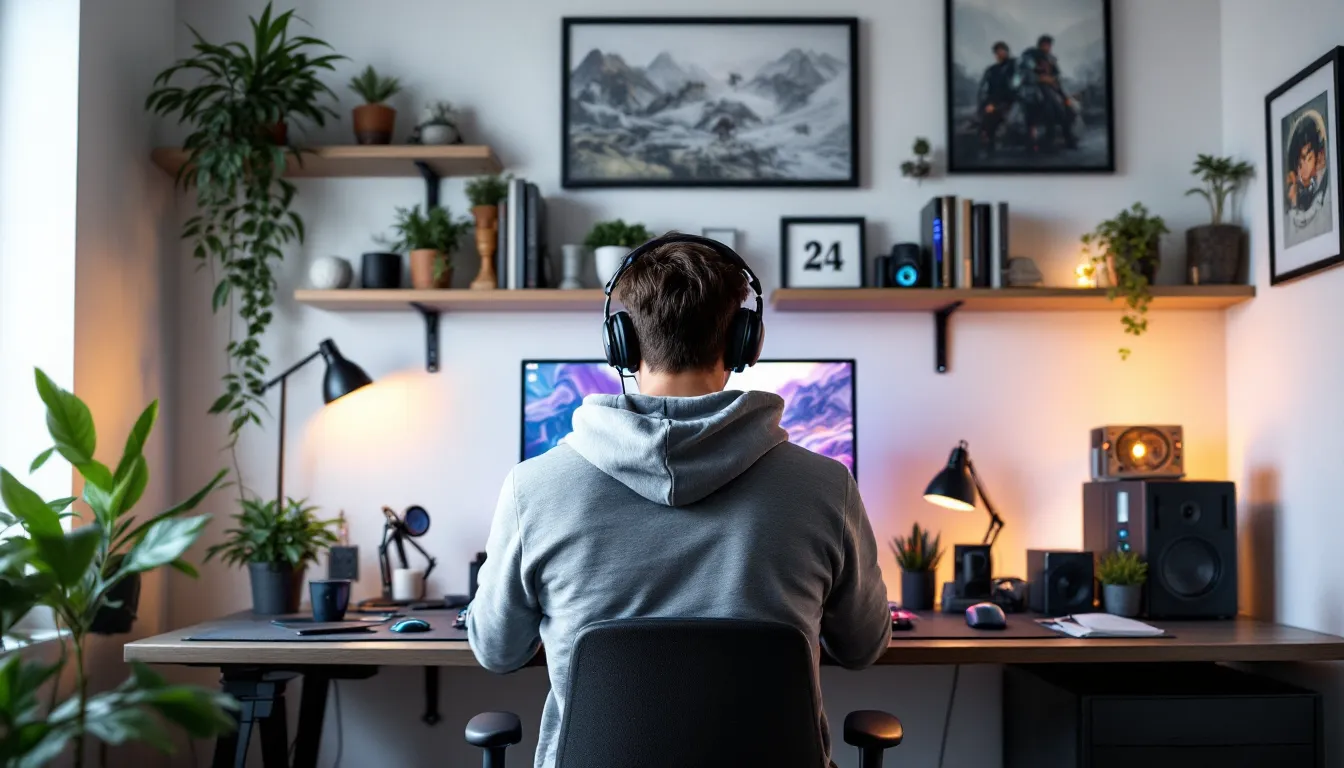
Creating a Comfortable and Productive Gaming Space
Your gaming space should be optimized for both performance and sustainability. Lighting matters more than most gamers realize, too much glare causes eye strain, while too little makes you drowsy during long sessions. Bias lighting behind monitors reduces eye fatigue without creating screen reflections.
Desk height and chair positioning affect aim and reaction time. Your monitor should be at eye level, about an arm’s length away. Your elbows should rest at a 90-degree angle when using keyboard and mouse. For controller players, ensure your seating allows relaxed shoulders and wrists.
Consider cable management, not just for aesthetics but for functionality. Tangled cables create drag on mouse movements and make peripheral swaps frustrating. Velcro ties and cable raceways keep things clean and accessible.
Budget-Friendly vs. Premium Setup Options
Budget Gaming Setup ($600-$800):
- Pre-built PC or current-gen console
- 1080p 75Hz monitor
- Basic mechanical keyboard or quality membrane
- Wired gaming mouse (Logitech G203, Razer Viper Mini)
- Entry-level headset (HyperX Cloud Stinger)
Mid-Range Setup ($1,500-$2,500):
- Custom-built PC (RTX 4060 Ti / RX 7700 XT level) or PS5/Xbox Series X
- 1440p 144Hz monitor
- Quality mechanical keyboard (Keychron, Ducky)
- Premium mouse (Logitech G Pro X, Razer DeathAdder V3)
- Good headset or separate mic setup
Premium Setup ($3,500+):
- High-end gaming PC (RTX 4080/4090, Ryzen 7/9 or Intel i7/i9)
- 4K 144Hz or 1440p 240Hz+ monitor
- Custom mechanical keyboard
- Wireless flagship mouse
- Studio-quality audio setup
The sweet spot for most gamers is the mid-range bracket. Diminishing returns hit hard above $2,500, you’re paying premium prices for incremental performance gains. A $1,800 setup will handle anything you throw at it in 2026 at high settings and competitive frame rates. Those exploring PC optimization techniques can squeeze even more performance from mid-range hardware.
Developing Your Gaming Skills and Strategy
Setting Personal Gaming Goals
Goals transform random play sessions into measurable progression. But generic goals like “get better” don’t cut it. Effective gaming goals are specific, measurable, and tied to observable metrics.
Good goal examples:
- Reach Diamond rank in Valorant by Season 8
- Improve Counter-Strike 2 headshot percentage from 45% to 55%
- Complete a Dark Souls trilogy no-death run
- Learn three new character matchups per week in Street Fighter 6
- Stream consistently three times per week for three months
Break larger goals into weekly or daily objectives. If your goal is hitting Diamond, your weekly goal might be mastering one agent’s utility setups. Daily goals could be 30 minutes of aim training or watching one VOD review.
Track your progress. Most competitive games now include detailed stats pages. Third-party tools like Tracker Network, Mobalytics, and Overwolf apps provide even deeper analytics. Reviewing your stats weekly keeps you accountable and helps identify weak points.
Practice Routines That Actually Work
Effective practice isn’t just playing more, it’s playing with purpose. Competitive gamers know that grinding ranked without targeted improvement is a waste of time. You’ll plateau hard without isolating specific skills.
Daily practice structure (60-90 minutes):
- Warm-up (10-15 min): Aim trainers (Aimlabs, Kovaak’s), death match, or practice mode
- Skill focus (20-30 min): Isolate one skill, crosshair placement, movement, ability timing, economy management
- Applied practice (30-45 min): Ranked or unranked matches implementing the focused skill
- Cool-down (5-10 min): Casual mode or aim trainer to end on a positive note
For fighting games, replace aim training with combo practice and frame data study. For MOBAs, focus on last-hitting, jungle pathing, or champion mechanics. According to research highlighted by gaming industry analysts, focused 30-minute practice sessions yield better results than unfocused 3-hour grinds.
Consistency beats intensity. Thirty minutes daily outperforms sporadic 4-hour weekend sessions. Your brain builds muscle memory through repetition over time, not marathon cramming.
Learning from Your Gameplay: VOD Reviews and Analytics
VOD review is the fastest way to improve, yet most players skip it entirely. Watching your own gameplay reveals patterns you’re blind to in the moment, why you always die in the same spot, which abilities you underutilize, when you make poor economy decisions.
VOD review process:
- Record your sessions: Use OBS, Medal, or built-in game recorders
- Focus on losses: Wins feel good but teach less than losses
- Ask specific questions: “Why did I die here?” “Was that peek necessary?” “Did I respect their cooldowns?”
- Compare to better players: Watch how high-ranked players handle the same situations
- Take notes: Write down 2-3 actionable changes per VOD
Analytics tools make this easier. Games like League of Legends and Valorant have robust stat tracking. Third-party platforms provide heat maps showing where you die most, which weapons perform best for you, and how your stats compare to players at your rank.
Review VODs once or twice weekly, not daily. You need time to carry out changes between reviews. Watching a VOD right after a frustrating loss often leads to emotional, not analytical, conclusions.
Curating Your Personal Gaming Library
Finding Games That Match Your Personality
Your game library should reflect your interests, not just what’s trending. The Steam library averaging 200+ unplayed games exists because people buy based on hype rather than personal fit. A tight, curated library you actually play beats a bloated collection you ignore.
Start by identifying your core gaming values. Do you value story over gameplay? Are you drawn to competitive challenges or creative expression? Do you prefer short, intense experiences or sprawling 100-hour epics?
Finding games by personality type:
- Achievement-driven: Roguelikes (Hades, Dead Cells), competitive ranked games, games with robust achievement systems
- Story-focused: Narrative RPGs (Baldur’s Gate 3, Cyberpunk 2077), walking simulators, visual novels
- Social gamers: Co-op titles (It Takes Two, Phasmophobia), MMOs, party games
- Creative types: Building games (Minecraft, Satisfactory), mod-heavy titles, sandbox games
- Challenge seekers: Souls-likes, precision platformers (Celeste), hardcore survival games
Use curators and recommendation engines wisely. Steam’s discovery queue, Xbox Game Pass recommendations, and specialized curators help surface games aligned with your tastes. Reviews from outlets like Game Informer provide detailed breakdowns of what each game offers.
Don’t be afraid to refund or drop games that don’t click. The sunk cost fallacy kills enjoyment. If you’re not feeling a game after 2-3 hours, move on. Your gaming time is valuable.
Balancing New Releases with Classic Favorites
FOMO drives gamers toward new releases, but classics deserve space in your rotation. Balancing new and familiar keeps gaming fresh without constant financial pressure.
The 70-30 rule works well: spend 70% of your gaming time on current interests (which can include both new releases and current multiplayer games) and 30% revisiting classics or exploring backlogs. This prevents burnout from always chasing the meta while keeping you connected to current gaming conversations.
Managing new releases:
- Set a monthly game budget and stick to it
- Use wishlists to track upcoming releases
- Wait for reviews before day-one purchases (unless it’s a franchise you’re confident in)
- Leverage subscription services (Game Pass, PlayStation Plus) for trying new releases risk-free
Classics offer unique value. They’re fully patched, have complete DLC bundles on sale, and have established communities with guides and mods. A first playthrough of The Witcher 3 in 2026 is just as rewarding as it was at launch, possibly more so with its next-gen update.
Some of the best players in tight-knit gaming circles maintain deep knowledge of a few core titles rather than surface-level experience with everything trending. Mastery of favorites often beats shallow dabbling in new releases.
Building Your Gaming Community and Network
Finding Like-Minded Gamers Online
Finding your gaming community is less about quantity and more about finding people who match your energy and playstyle. A tight group of five regular squad members beats a thousand-person Discord where nobody knows your name.
Start with game-specific communities. Most multiplayer games have official Discords, subreddits, or forums where players organize. But don’t stop there, look for subcommunities aligned with your specific interests. If you’re into competitive Apex Legends but hate toxic teammates, search for communities that explicitly prioritize positive comms.
Where to find gaming communities in 2026:
- Discord servers: Game-specific, streamer communities, niche interest groups
- Reddit: r/gaming, r/patientgamers, game-specific subreddits
- Guild Finder tools: Built into World of Warcraft, Final Fantasy XIV, Destiny 2
- LFG platforms: GamerLink, Discord LFG channels, console built-in LFG
- Community gaming hubs: Spaces focused on specific values like inclusive gaming environments or faith-based communities
Vetting potential gaming friends is important. Play a few unranked matches before committing to regular sessions. Pay attention to how they handle losses, whether they blame teammates, and if their schedule actually aligns with yours. Good gaming chemistry is rare, when you find it, nurture it.
Consider time zone compatibility and life stage. College students and working professionals have vastly different availability. Parents often need gaming communities that understand sudden AFKs.
Streaming and Content Creation for Personal Branding
Streaming and content creation aren’t just for aspiring pros anymore. In 2026, they’re legitimate ways to document your gaming journey, build accountability, and connect with like-minded players. You don’t need thousands of viewers to get value from streaming.
Starting small with streaming:
- Platform choice: Twitch for gaming focus, YouTube for discoverability, TikTok for short-form highlights
- Minimal setup: Decent mic ($50-100), basic webcam optional, OBS or Streamlabs for software
- Consistency matters: Stream same days/times weekly so the few people who find you know when to return
- Niche down: “Variety streamer” is the hardest path. Pick 1-2 core games initially
Content creation offers more flexibility than live streaming. You can record sessions, edit out downtime, and post on your schedule. YouTube Shorts, TikTok, and Instagram Reels make short-form highlights accessible even with basic editing skills.
Don’t expect overnight growth. The average new streamer gets 0-3 viewers for months. Treat early streaming as practice, dialing in your audio, getting comfortable talking while playing, figuring out your on-camera personality. The technical skills you build now matter when and if your audience grows.
Networking with other small streamers beats grinding alone. Raid each other, collaborate on content, share tips. Growing together beats competing for viewers.
Balancing Gaming with Real Life
Healthy Gaming Habits and Time Management
Gaming as a hobby deserves time and investment, but it shouldn’t consume everything else. Healthy gaming habits look different for everyone, a college student can sustainably game 40+ hours weekly, while a working parent might cap at 10. The question isn’t “how much is too much” universally, it’s whether gaming enhances or detracts from your overall life satisfaction.
Time management strategies:
- Set session timers: Use phone alarms or PC tools like ManicTime to track actual play hours
- Schedule gaming blocks: Treat gaming like any other hobby, designate specific times rather than defaulting to “whenever I’m free”
- Prioritize responsibilities first: The classic “work before play” actually reduces gaming guilt and increases enjoyment
- Use gaming as a reward: Finishing work tasks unlocks guilt-free gaming time
Physical health directly impacts gaming performance. Hand and wrist stretches prevent RSI and carpal tunnel, critical for long-term gaming. The 20-20-20 rule (every 20 minutes, look at something 20 feet away for 20 seconds) reduces eye strain. Standing desks or taking movement breaks between matches keeps blood flowing.
Sleep trumps grind sessions. You’ll climb ranked faster with 8 hours of sleep and focused practice than staying up until 3 AM in a tilted state. Late-night gaming tanks your reaction time, decision-making, and learning ability. Practicing secure gaming habits also includes protecting your overall wellbeing, not just your accounts.
Avoiding Burnout While Staying Passionate
Gaming burnout is real and increasingly common as games adopt endless content treadmills and FOMO-driven season passes. The symptoms are obvious: logging in feels like a chore, you’re playing out of obligation rather than enjoyment, and you’re more frustrated than fulfilled.
Signs you’re approaching burnout:
- Gaming feels like work, not recreation
- You’re only playing to maintain rank or complete dailies
- Losses trigger disproportionate frustration
- You’re not excited about new content or updates
- Other hobbies and relationships suffer
Preventing burnout starts with diversification. Don’t put all your gaming time into one competitive title. Mix in single-player games, different genres, or creative outlets. Taking a week off from your main game often reignites passion more effectively than forcing through burnout.
Recognize when you’re playing because you want to versus because you feel you have to. Battle passes and daily login rewards are designed to create obligation. If a game’s progression system makes you anxious rather than excited, that’s a red flag.
Seasonal breaks work well. Many competitive players take entire seasons off, returning refreshed when the meta shifts. Your rank will still be there. The game will still be there. Your mental health matters more than maintaining a digital badge.
Reconnect with why you started gaming in the first place. Was it the challenge? The escapism? The social connection? If your current gaming habits don’t serve those original motivations, it’s time to adjust.
Conclusion
Building your personal gaming identity isn’t about following someone else’s template, it’s about understanding what makes gaming meaningful to you and structuring your hobby around that core. Whether you’re a competitive grinder chasing ranks, a narrative explorer diving deep into story worlds, or a social player who just wants consistent squad mates, owning your gaming identity leads to more satisfaction and less FOMO-driven chaos.
The best gaming setup isn’t the most expensive one: it’s the one that matches how you actually play. The best gaming library isn’t the biggest: it’s the one you actually engage with. And the best gaming community isn’t the largest Discord server: it’s the group that makes you excited to log on.
In 2026, gaming offers more paths than ever before. The players who thrive are the ones who define success on their own terms, set goals aligned with their values, and build sustainable habits that let them enjoy gaming for years to come. Start with self-awareness, stay honest about what brings you joy, and don’t be afraid to evolve as your interests shift. Your gaming identity is yours to build, make it count.