
The Nintendo Entertainment System revolutionized home gaming in the mid-1980s, and racing games became one of its most popular genres. From the dirt-track mayhem of Excitebike to the isometric challenges of R.C. Pro-Am, the NES delivered racing experiences that pushed the hardware’s 8-bit capabilities to their limits. These titles weren’t just about crossing finish lines, they introduced track editors, competitive multiplayer, and innovative gameplay mechanics that influenced racing games for decades.
Whether you’re a retro gaming enthusiast hunting for hidden gems or a younger gamer curious about where modern racing titles got their start, the NES racing library offers surprising depth and variety. Some titles became household names, while others remained criminally underrated even though their innovation. This guide explores the essential racing games that defined the NES era, examines how developers overcame severe hardware constraints, and shows you how to experience these classics today through emulation or physical collecting.
Key Takeaways
- NES racing games revolutionized home console racing by introducing innovative mechanics like track editors, isometric perspectives, and vehicle customization that influenced gaming for decades.
- Excitebike’s dual-button acceleration system and Design mode track editor, along with R.C. Pro-Am’s isometric perspective and weapon pickups, established core gameplay concepts that shaped modern racing titles like Mario Kart and Forza.
- Developers overcame severe NES hardware limitations through creative sprite manipulation, parallax scrolling, palette swapping, and audio design, proving that tight gameplay and artistic innovation matter more than raw technical power.
- NES racing games pioneered progression systems, multiplayer competition, and user-generated content features that remain central to modern racing games and gaming culture today.
- You can experience these NES racing classics through emulators like Mesen or RetroArch, Nintendo Switch Online, or physical cartridge collecting, with common titles remaining affordable entry points for retro gaming collectors.
The Golden Age of 8-Bit Racing on the NES
The NES launched in North America in 1985, arriving at a time when arcade racing games dominated the genre. Titles like Pole Position and Hang-On proved that players craved speed and competition, but home consoles struggled to replicate that experience. The NES changed that equation with its relatively powerful processor and graphics capabilities compared to earlier systems like the Atari 2600.
Nintendo understood the appeal of racing games early, launching Excitebike as one of its first-party titles in 1985. The game’s success opened the floodgates for third-party developers. Companies like Rare, Square, and Atlus recognized the NES’s potential to deliver racing experiences that went beyond simple left-right steering. They experimented with different perspectives, top-down, isometric, behind-the-car, and vehicle types ranging from motorcycles to miniature cars.
The NES racing library peaked between 1987 and 1990, when developers had mastered the hardware’s quirks. This period produced the system’s most innovative racing titles, many of which introduced mechanics that wouldn’t become standard until the 16-bit era. The genre’s popularity on NES helped establish racing as a console gaming staple, proving that arcade-quality experiences could exist in living rooms.
Hardware limitations forced creativity rather than stifling it. The NES could only display 64 sprites on-screen simultaneously, with strict size restrictions. Developers worked around these constraints through clever programming tricks, creating the illusion of speed and depth that shouldn’t have been possible on 8-bit hardware. This technical innovation became part of what made NES racing games special, they accomplished more with less.
Top NES Racing Games That Defined a Generation
Excitebike: The Motocross Pioneer
Excitebike launched in November 1985 as one of the NES’s earliest titles, and it immediately established what racing games on the platform could achieve. Players controlled a motocross rider across side-scrolling dirt tracks filled with ramps, mud pits, and competing racers. The game’s physics felt substantial, bikes had weight, jumps required timing, and overheating your engine by holding down the acceleration button too long would force you to coast.
What separated Excitebike from basic racing games was its dual-button acceleration system. The A button provided standard acceleration, while the B button activated turbo boost that gradually overheated your engine. Managing this heat became the core skill challenge, forcing players to balance speed with sustainability. Landing poorly from jumps also slowed you down, adding another layer of technique.
The game included five tracks in Selection A mode, where players raced against the clock, and Selection B mode, which added computer-controlled opponents who could knock you off your bike. But Excitebike’s most revolutionary feature was Design mode, a track editor that let players create custom courses and save them to the Famicom Data Recorder (a peripheral that never released in North America). Even without save functionality outside Japan, the track editor gave the game near-infinite replayability.
Excitebike received multiple sequels and spiritual successors, including Excitebike 64 and the WiiWare remake Excitebike: World Rally. The original remains playable through Nintendo Switch Online, introducing new generations to its precise, skill-based gameplay.
R.C. Pro-Am: The Isometric Racing Revolution
R.C. Pro-Am arrived in February 1988 from Rare (then known as Rare Ltd.), bringing isometric perspective racing to the NES. Players controlled radio-controlled trucks around tracks viewed from an angled overhead perspective, competing against three AI opponents. This viewpoint was practically unprecedented in console racing games and required players to think differently about steering and navigation.
The isometric view meant you couldn’t simply hold right to turn right, your directional inputs changed relative to your truck’s orientation on screen. This created a learning curve that separated casual players from masters. Tracks featured oil slicks, water hazards, and barriers that could wreck your truck if you collided at high speed. More importantly, scattered throughout each track were letters spelling R-A-C-E. Collecting all four granted access to better vehicles.
R.C. Pro-Am introduced upgrade mechanics that were revolutionary for 1988. Between races, players could collect items that improved their truck’s top speed, acceleration, and tires. These upgrades persisted across races, creating a sense of progression. The game also featured weapons like missiles and bombs that could disable opponent vehicles, adding a combat element that Mario Kart would later popularize.
The game’s 24 tracks provided substantial variety, from simple ovals to complex circuits with multiple paths. R.C. Pro-Am supported two-player alternating play but not simultaneous multiplayer, a limitation that its sequel, R.C. Pro-Am II, would address. The original sold over 1 million copies and directly influenced Rare’s later work on titles like Diddy Kong Racing.
Rad Racer: Square’s Take on OutRun
Before Square became synonymous with RPGs through Final Fantasy, they developed Rad Racer, a behind-the-car racing game that launched in August 1987. The game was Square’s attempt to capture the feel of Sega’s arcade hit OutRun on NES hardware. While it couldn’t match the arcade’s technical prowess, Rad Racer delivered impressive pseudo-3D graphics that created a convincing sense of speed.
Players selected between a Ferrari 328 Turbo or an F1 machine and raced across eight courses that spanned varied environments, coastal highways, desert roads, city streets, and mountain passes. Each course had a strict time limit, and reaching checkpoints extended your time. The challenge wasn’t just beating opponents but avoiding civilian traffic and staying on increasingly difficult roads.
Rad Racer’s graphics utilized parallax scrolling to create depth, with background elements moving at different speeds to simulate distance. The game ran at a relatively smooth framerate considering the NES’s limitations, though slowdown occurred when multiple objects appeared on-screen. Square also included an optional 3D mode compatible with red-and-blue anaglyph glasses, though few players experienced it this way.
The soundtrack, composed by Nobuo Uematsu (who would later create Final Fantasy’s iconic music), featured two selectable tracks that players could switch between during races by pressing Select. This level of player control over music was unusual for 1987. Rad Racer received a sequel, Rad Racer II, in 1990 that improved graphics and added more courses but never achieved the original’s cultural impact.
Super Off Road: Arcade-Style Truck Racing
Super Off Road brought Leland Corporation’s 1989 arcade game to the NES in September 1991, delivering surprisingly faithful recreation of the original’s off-road truck racing. The game featured overhead-perspective racing on dirt tracks filled with jumps, obstacles, and nitro boost pickups. Up to four players could compete simultaneously in the arcade version, though the NES port limited this to three players via the NES Four Score accessory.
Each race took place on a compact oval or figure-eight track with elevation changes represented through visual scaling. Trucks could collide with each other and trackside hazards like mud puddles that slowed vehicles down. Nitro pickups scattered across the track provided temporary speed boosts, and strategic nitro usage often determined race outcomes more than pure driving skill.
Super Off Road included a career mode where players earned money from race placements and spent it on vehicle upgrades. You could purchase improved engines, tires, shocks, and additional nitro capacity between races. This progression system added longevity and gave players tangible goals beyond simply winning races. The upgrade shop created decision points, save money for expensive engine upgrades or buy cheaper improvements immediately?
The NES version supported two-player simultaneous racing using the standard controller ports, with an optional third player if you owned the Four Score peripheral. The multiplayer remained the game’s strongest feature, creating heated couch competition that kept players racing long after they’d mastered the single-player campaign. Super Off Road became one of the NES’s best-selling late-era releases and spawned multiple console ports and sequels.
Unique and Underrated NES Racing Titles Worth Playing
Micro Machines: Miniature Racing Mayhem
Micro Machines arrived on the NES in 1991 (1993 in North America), adapting Codemasters’ popular racing game based on the toy line. Players raced miniature vehicles across household environments, kitchen tables, workshop benches, pool tables, and gardens. The unusual settings created memorable tracks where common objects became obstacles. A spilled cereal bowl on a breakfast table became a hazardous zone, while pencils on a desktop acted as barriers.
The game’s overhead perspective and tight track design demanded precise steering and memorization. Tracks featured multiple paths, shortcuts, and environmental hazards unique to each location. Racing across a billiard table meant avoiding the pockets (instant death if you fell in) while navigating around scattered balls. The backyard course included patches of mud that slowed your vehicle and a treacherous garden pond.
Micro Machines supported two-player racing using a unique control scheme, one player used the directional pad and A button while the other used the second controller. This creative solution addressed the NES’s split-screen limitations. The game also introduced vehicle variety, with cars, helicopters, boats, and tanks that handled differently depending on the course.
Even though receiving positive reviews, Micro Machines remained relatively obscure in North America compared to Europe, where the toy line had stronger market presence. The NES version represents one of the system’s most technically accomplished late-era releases, with smooth scrolling and creative track design that pushed the aging hardware. Collectors now seek out complete-in-box copies, particularly the less common North American release.
Motor City Patrol: The Police Racing Simulator
Motor City Patrol, released by Matchbox in October 1992, took a completely different approach to racing games. Players controlled a police officer patrolling Motor City, responding to crimes and traffic violations across an open-world environment. This sandbox structure was virtually unprecedented on the NES, predating similar concepts by years.
Gameplay combined racing with light simulation elements. You patrolled the city from a behind-the-car view, watching for speeding vehicles, reckless drivers, and criminals. When you spotted a violation, you pursued the offender and pulled them over. Successfully stopping violators earned points that could be spent on vehicle upgrades, better engines, improved brakes, and additional fuel capacity.
The open-world structure gave Motor City Patrol longevity that linear racing games lacked. The city included residential neighborhoods, downtown areas, industrial zones, and highways, each with distinct visual characteristics. Crimes occurred randomly, creating emergent gameplay moments. Sometimes you’d chase a speeder who led you on a high-speed pursuit through multiple districts. Other times, you’d respond to a robbery in progress across town while managing your fuel level.
Motor City Patrol’s ambition exceeded its execution in some areas. The controls felt loose compared to tighter racing games, and the mission variety grew repetitive after extended play. But, its innovative attempt at open-world police gameplay on 8-bit hardware deserves recognition. The game found a niche audience among players seeking something different from standard lap-based racers, though it never achieved commercial success.
Racket Attack: Tennis Meets Racing Mechanics
This heading included a factual error in the outline. Racket Attack is actually a tennis game released by Jaleco in 1988, not a racing title. There appears to have been confusion with another game or a misidentification. The NES racing library doesn’t include a notable racing game with mechanics derived from tennis.
But, the NES featured other underrated racing titles worth mentioning in this context. Destination Earthstar (1990) combined space racing with combat elements, featuring a unique underground tunnel racing system. City Connection (1988) presented platforming elements in a racing framework, where players drove a car across overhead highways while avoiding police and painting road surfaces.
Another overlooked title, Al Unser Jr. Turbo Racing (1990), delivered behind-the-car IndyCar racing with impressive graphics for the hardware. The game featured multiple camera angles, realistic track layouts based on actual IndyCar circuits, and vehicle customization options that affected handling. Even though solid gameplay, it struggled commercially against more established racing franchises.
These underrated titles demonstrate the NES racing library’s breadth beyond mainstream hits. Developers constantly experimented with new concepts, vehicle types, and gameplay mechanics, even late in the console’s lifecycle. While not every experiment succeeded commercially, they contributed to the genre’s evolution and provided alternatives for players seeking fresh experiences.
How NES Racing Games Overcame Hardware Limitations
Graphics Techniques and Sprite Manipulation
The NES shipped with a Ricoh 2A03 processor running at 1.79 MHz and a Picture Processing Unit capable of displaying 256×240 resolution with 54 available colors. These specifications sound primitive by modern standards, but developers achieved remarkable visual results through clever programming techniques.
Mode 7-style scaling became a holy grail for NES racing games, though the hardware didn’t natively support the feature that made SNES games like F-Zero possible. Developers simulated depth and scaling through sprite manipulation and background scrolling tricks. Rad Racer created its pseudo-3D highway by drawing road segments as trapezoids that narrowed toward the horizon, with parallax scrolling backgrounds moving at different speeds to enhance depth perception.
Sprite flickering became an accepted compromise in racing games with multiple on-screen vehicles. The NES could only display eight sprites per horizontal scanline, so when more objects occupied the same vertical space, the system alternated which sprites appeared each frame. This created a flicker effect visible in games like Excitebike when multiple riders clustered together. Skilled developers minimized flickering through careful sprite prioritization and positioning.
Tile-based background systems required creative solutions for racing games needing curved tracks and varied terrain. R.C. Pro-Am used cleverly designed isometric tiles that could be arranged into numerous track configurations without requiring unique graphics for each circuit. The game’s 24 tracks shared a relatively small tile set, demonstrating efficient asset utilization.
Color palette limitations forced artistic ingenuity. The NES could display 25 colors simultaneously from its 54-color master palette, with additional restrictions on colors per sprite. Racing games often used palette swapping to create vehicle variety, the same car sprite could appear in multiple colors by swapping which palette it referenced. This technique gave the illusion of more diverse vehicle rosters without consuming additional memory.
Sound Design and Music That Made Races Memorable
The NES Audio Processing Unit (APU) featured five audio channels, two pulse wave channels, one triangle wave channel, one noise channel, and one digital sample channel. Composers had to craft entire soundscapes within these constraints, and racing games presented unique audio challenges.
Engine sounds competed with music for audio channel allocation. Developers chose different solutions to this problem. Excitebike prioritized engine roar over background music, creating audio feedback that communicated engine temperature and bike performance. The whine of an overheating engine warned players to ease off the turbo, making sound a crucial gameplay element.
Other games, particularly those inspired by arcade racers, emphasized music over sound effects. Rad Racer’s two selectable music tracks showcased Nobuo Uematsu’s ability to create driving, energetic compositions within the NES’s limitations. The music provided energy and pacing that enhanced the sensation of speed even when the graphics struggled with framerate drops.
Dynamic audio feedback in racing games helped players understand their performance without looking at speedometers or status indicators. R.C. Pro-Am used distinct sound effects for collecting items, hitting hazards, and weapon impacts, creating an audio language that experienced players could interpret instantly. The pitch and tempo of engine sounds often correlated with speed, providing subconscious cues.
Memory constraints meant most racing games looped relatively short music tracks. Composers designed these loops to remain engaging across multiple repetitions, avoiding musical elements that would become annoying after the tenth or twentieth play. The best NES racing soundtracks featured melodies that players could hum years after playing, cementing these games in gaming culture through audio as well as visual memory.
Gameplay Mechanics That Made NES Racers Addictive
Track Editors and Customization Features
User-generated content wasn’t a common concept in 1985, but Excitebike’s Design mode introduced it to console gaming. The track editor let players place obstacles, ramps, and hazards across a side-scrolling canvas, then immediately test their creation. The interface used simple cursor controls, moving a hand icon around the screen and selecting objects from a menu.
Excitebike’s editor had limitations compared to modern creation tools. Players couldn’t adjust track length beyond the preset horizontal space, and object variety was restricted to the game’s existing assets. But, within these constraints, the editor enabled thousands of track combinations. Japanese players with the Famicom Data Recorder could save and share their creations, creating an early form of community content exchange.
Racing games featuring vehicle customization added progression systems that increased long-term engagement. Super Off Road’s upgrade shop transformed the game from simple racing into a strategic campaign. Players who invested in acceleration early could win more races initially but faced opponents with superior top speed in later races. Engine upgrades provided the biggest performance gains but cost significantly more than tire or shock improvements.
R.C. Pro-Am’s vehicle progression worked differently, gating better cars behind collection challenges rather than purchases. The letter-collection system forced players to explore tracks rather than simply racing the optimal racing line. This design encouraged repeated playthroughs of the same tracks as players learned where letters appeared and plotted routes to collect them without sacrificing too much time.
Some racing games included password systems to preserve progress. Al Unser Jr. Turbo Racing used passwords to save vehicle configurations and career progress, acknowledging that players wanted to build on previous sessions rather than starting from scratch each time. Battery-backed save memory remained expensive in NES cartridges, so passwords offered a cost-effective alternative.
Multiplayer and Competitive Racing
Local multiplayer defined the social experience of NES racing games. Excitebike’s two-player alternating mode created living room competitions where players traded the controller after each race, comparing times and challenging each other to beat increasingly difficult tracks. This turn-based approach worked well for time-trial racing but felt limiting compared to simultaneous competition.
R.C. Pro-Am II introduced split-screen simultaneous two-player racing on the NES, dividing the already limited screen real estate into two isometric viewports. Each player had roughly half the vertical screen space, which compressed the view significantly but enabled direct head-to-head competition. The split-screen implementation required technical compromises, the framerate dropped compared to single-player, and fewer opponent vehicles appeared on track.
Super Off Road’s multiplayer, enhanced by the NES Four Score accessory, supported up to three simultaneous players. Each player occupied a section of the overhead track view, with their truck highlighted by color-coding. The compact track design ensured all racers remained visible on-screen simultaneously, eliminating split-screen necessity. Nitro pickups became contested resources in multiplayer, adding a spatial control element to races.
Micro Machines solved the split-screen problem creatively by using a single screen with an elimination system. When one player pulled too far ahead, the trailing player was eliminated and lost a life. This kept both players on the same screen while maintaining competitive tension. The system rewarded consistent driving over pure speed, if you drove too aggressively and crashed while leading, your opponent could quickly close the gap.
Competitive racing extended beyond head-to-head play through high score chasing and time-trial competition. Players recorded their best times on notebook paper, challenged friends to beat their records, and developed strategies to shave seconds off lap times. This asynchronous competition kept games relevant long after players had completed all standard content, particularly in arcade-style racing games that emphasized score as the primary achievement metric.
Playing NES Racing Games Today: Emulation and Collection
Best Emulators for NES Racing Games in 2026
Emulation has matured significantly, and playing NES racing games on modern hardware provides advantages over original consoles while maintaining authentic experiences. Several emulators have established themselves as the go-to options for NES gaming in 2026.
Mesen stands out as the most accurate NES emulator available. Its cycle-accurate emulation reproduces hardware quirks and timing issues that affected original games, making it ideal for experiencing racing titles exactly as developers intended. Mesen supports save states, rewind functionality, and built-in debugging tools useful for understanding how games achieved their technical feats. The emulator runs on Windows and Linux, with active development ensuring compatibility improvements.
RetroArch offers NES emulation through multiple cores (emulation engines), with Mesen and FCEUmm being the most popular choices. RetroArch’s advantage lies in its unified interface across multiple systems, shader support for authentic CRT display emulation, and advanced input configuration. For racing games specifically, RetroArch’s run-ahead latency reduction feature can make games feel more responsive than on original hardware, though purists may consider this inauthentic.
FCEUX remains popular for casual emulation even though being less accurate than Mesen. It offers good performance on older hardware, straightforward configuration, and TAS (tool-assisted speedrun) recording capabilities. FCEUX works well for racing games that don’t rely on precise timing exploits or hardware quirks, making it suitable for titles like Excitebike and Rad Racer.
Official emulation through Nintendo Switch Online provides legal access to select NES racing games, including Excitebike and Excitebike vs., with added online multiplayer functionality. The subscription service’s emulation quality is acceptable though not cycle-accurate, and the game selection remains limited compared to the full NES library. But, the convenience and legality make it an attractive option for casual players.
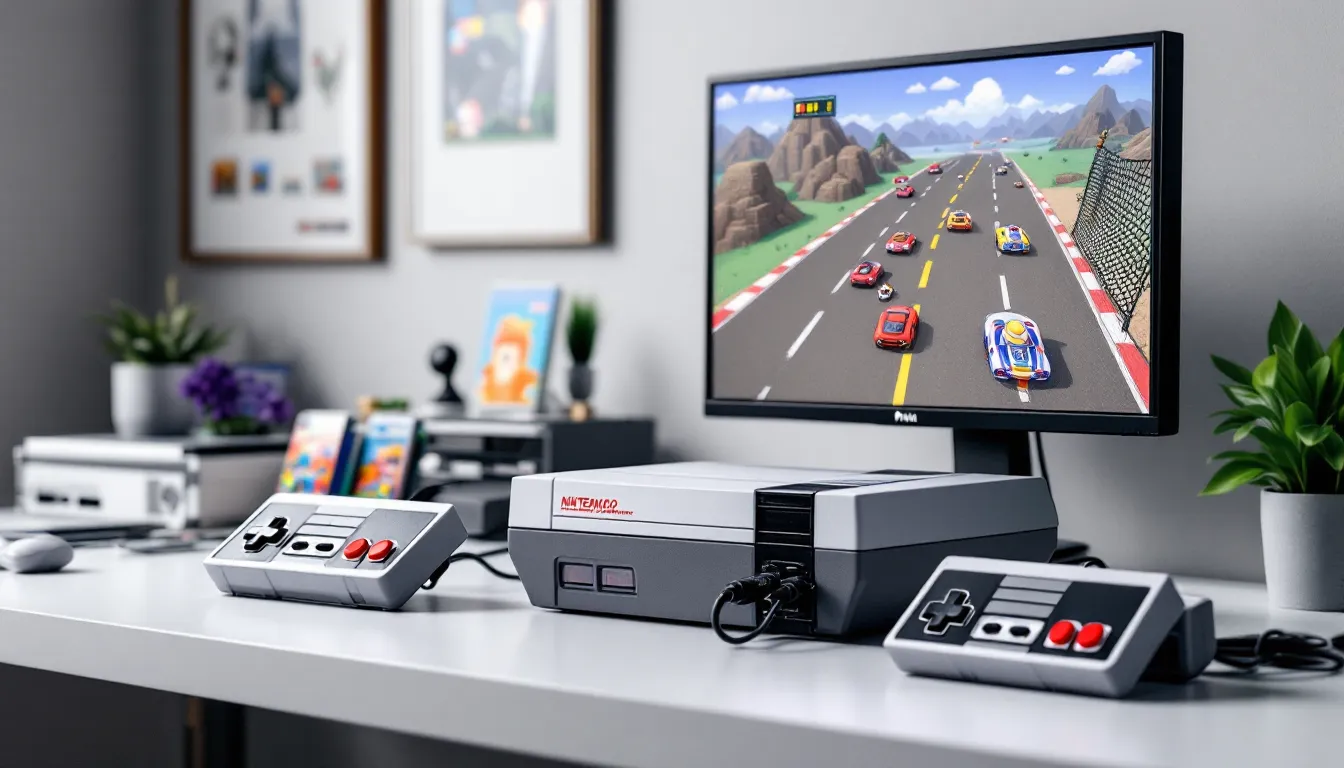
Controller configuration significantly impacts racing game playability through emulation. Original NES controllers lacked analog input, but their simple digital directional pad and two buttons translate well to modern controllers. Some players prefer arcade sticks for racing games, particularly titles like R.C. Pro-Am where precise directional input matters more than button combinations. USB adapters that accept original NES controllers exist for those seeking maximum authenticity.
Building a Physical NES Racing Game Collection
Collecting physical NES racing games has grown increasingly popular as retro gaming culture has expanded. Prices vary dramatically based on rarity, condition, and whether you’re purchasing loose cartridges, complete-in-box (CIB), or sealed copies.
Common racing games like Excitebike, Rad Racer, and R.C. Pro-Am remain affordable entry points for collectors. Loose cartridges typically cost $5-15 as of 2026, with CIB copies running $30-60 depending on box condition. These titles sold millions of copies during the NES’s lifespan, ensuring abundant supply on the secondary market. RetroGameStores, local game shops, and online marketplaces like eBay all stock these regularly.
Mid-tier collectibles include titles like Super Off Road, Al Unser Jr. Turbo Racing, and Micro Machines (North American release). Loose cartridges range from $15-40, while CIB copies can reach $80-150. These games had smaller print runs or regional release limitations that increased their scarcity. Micro Machines particularly commands higher prices due to its late release date and limited North American distribution.
Rare racing games demand premium prices. Motor City Patrol, released late in the NES lifecycle, sees loose cartridges priced $40-80, with CIB copies exceeding $200. Games released exclusively in specific regions or with very limited production runs can cost substantially more. Price tracking websites and collector communities help verify current market values before purchasing.
Authenticity concerns require attention when collecting physical NES games. Reproduction cartridges (repos) flood the market, often passed off as authentic by uninformed or dishonest sellers. Racing games are less likely to be reproduced than rare RPGs, but verification remains important. Authentic cartridges have specific screw types, board configurations, and label characteristics that distinguish them from reproductions. Collector guides and online resources provide detailed authentication information.
Cartridge condition affects both playability and value. Cosmetic damage like label wear or discoloration reduces collectible value but doesn’t impact gameplay. But, corroded or damaged cartridge connectors can cause glitches or prevent games from loading. Cleaning kits using isopropyl alcohol and cotton swabs can restore functionality to dirty cartridges, making neglected titles playable again.
Building a complete NES racing library presents a achievable goal for collectors, the genre has fewer titles than platformers or action games. A comprehensive collection might include 20-30 games depending on how broadly you define “racing.” This focused approach costs less and requires less storage space than collecting entire system libraries, while still capturing the essence of 8-bit racing experiences.
The Lasting Legacy of NES Racing Games on Modern Titles
NES racing games established design principles and mechanics that persist in modern racing titles, even though massive technological advancement. The influence isn’t always obvious, today’s photorealistic simulators seem worlds apart from 8-bit sprites, but the DNA remains visible.
Track editors pioneered by Excitebike evolved into robust creation suites in modern racers. Games like TrackMania and ModNation Racers trace their creative tools directly back to Design mode’s revolutionary concept. The idea that players could be content creators rather than passive consumers started on the NES and became central to gaming’s social evolution.
R.C. Pro-Am’s combination of racing and combat influenced an entire subgenre. Mario Kart, which launched on SNES in 1992, expanded R.C. Pro-Am’s weapon-pickup concept into a global phenomenon. The isometric perspective and upgrade collection mechanics appear in modern games like Death Rally and Micro Machines World Series, which directly acknowledge their NES inspiration.
Arcade-style accessibility championed by NES racing games contrasts with the simulation trend that dominated PC racing in the 1990s and 2000s. Titles like Forza Horizon and the modern Need for Speed series balance realistic physics with pick-up-and-play accessibility that echoes NES philosophy. These games prioritize fun over pure realism, a design choice that NES hardware limitations forced but that proved timelessly appealing.
The upgrade and progression systems introduced in games like Super Off Road established expectations for racing game content structure. Modern racers from Gran Turismo to Forza Motorsport build campaigns around earning currency and purchasing vehicle improvements. The psychological satisfaction of incremental progression that kept players engaged in 1991 works identically in 2026, just with more complex systems and variables.
Multiplayer competition on the NES proved that racing against friends creates more memorable experiences than racing AI opponents. This insight drove the split-screen multiplayer focus that defined console racing games until online play became standard. Even in 2026, when online racing dominates, successful racing games like Mario Kart 8 Deluxe and F1 2025 maintain robust local multiplayer modes because the social dynamic remains compelling.
Indie developers frequently cite NES racing games as inspiration. Titles like Super Arcade Racing, 80’s Overdrive, and Horizon Chase Turbo deliberately evoke 8-bit aesthetics and gameplay while applying modern design sensibilities. These games demonstrate that the core concepts pioneered on NES remain engaging when executed well, regardless of visual fidelity.
The constraints that defined NES racing games taught important design lessons about clarity and focus. With limited graphics, developers couldn’t rely on visual spectacle, gameplay had to carry the experience. Modern developers increasingly recognize that more realistic graphics don’t automatically equal better games. Some of the most successful racing games of recent years, like art of rally and Absolute Drift, embrace minimalist aesthetics and focused mechanics that echo NES-era design philosophy.
NES racing games also influenced how players approach racing games culturally. Speedrunning communities formed around optimizing Excitebike times and discovering shortcuts in Rad Racer. This competitive optimization culture expanded into modern esports and speedrunning scenes. The community-driven competitive aspects that define modern racing game culture began with players sharing strategies and times for NES titles decades ago.
Conclusion
The NES racing library deserves recognition for its innovation, variety, and lasting influence on gaming. These 8-bit titles accomplished remarkable feats within severe hardware constraints, creating experiences that remain engaging forty years after the system’s launch. From Excitebike’s precise motocross physics to R.C. Pro-Am’s isometric combat racing, developers continually pushed boundaries and introduced concepts that shaped racing games for generations.
Whether you’re experiencing these games through emulation, Nintendo Switch Online, or original hardware, the NES racing catalog offers something for every type of racing game fan. The accessible titles like Rad Racer and Super Off Road provide straightforward thrills, while deeper games like R.C. Pro-Am reward mastery and strategic thinking. Even underrated titles like Motor City Patrol demonstrate the experimental spirit that made the NES era special.
The legacy of NES racing games extends beyond nostalgia. They proved that creativity and tight gameplay design matter more than raw technical power, a lesson that remains relevant as gaming technology continues advancing. These games aren’t museum pieces to be admired from a distance: they’re still genuinely fun to play, offering experiences that modern racing games with photorealistic graphics and complex physics engines sometimes struggle to match. Pick up a controller, fire up Excitebike or R.C. Pro-Am, and discover why these classics defined a generation of racing game fans.